Weekend Reading
What fresh hell is this? #Incompetence #Corruption #Affordability

“Seventeen years ago, while serving as an Iran desk officer in the U.S. State Department, I asked a more veteran colleague about the latest inflammatory statement by Mahmood Ahmadinejad, then the Iranian president. My colleague responded: ‘Stop paying attention to Ahmadinejad. Only focus on Iranian Supreme Leader Ali Khamenei. He makes the important decisions.’ He added: ‘But don’t worry. Change is coming. Khamenei’—who was then 69 and widely believed to have cancer—’could die at any moment.’ Khamenei did not die. Not until two weeks ago, when U.S. President Donald Trump and Israeli Prime Minister Benjamin Netanyahu did what nature had not and ended the supreme leader’s 36-year stewardship of the Islamic Republic. Khamenei left a damning legacy. Since his ascension in 1989, the Iranian rial has lost almost all of its value against the dollar. Although rich in natural resources, Iran consistently experiences electricity and water shortages. Over the past year, food prices surged more than 70 percent. Iran’s economic woes are in large part the consequence of a foreign policy designed to counter U.S. interests. When faced with popular discontent, Khamenei consistently resisted reforms and resorted to violence to repress his people—most notably in January, when his regime murdered thousands of its citizens. But he clearly prepared Iran for this moment. Confronted with a truly existential threat, Iran has mounted a much more deliberate, decentralized, and effective response than many expected, striking not only Israeli territory and U.S. diplomatic and military installations but also civilian targets throughout the Persian Gulf, including airports, hotels, and energy infrastructure. Trump likely wants to declare victory soon. The Iranian military has been severely degraded. Israel may be running low on missile interceptors, and keeping global markets stable will require reopening the Strait of Hormuz, which Iran has declared closed to its enemies. But he cannot force surrender on a government that refuses it. Even after the heavy damage to Iran’s military, the regime that Khamenei put in place has powerful incentives to pursue continued conflict, and it retains a variety of tools to sustain a war of attrition.” (Nate Swanson/Foreign Affairs)
“One of the reasons I remember Ghislaine Maxwell so clearly is because of moments like this. An encounter at Jeffrey Epstein's suite of offices when in a hallway Maxwell cut me off, looming over me, clearly wanting to chat so I gave her a compliment. To be polite. She lit up and said, ‘I keep myself thin because that’s what Jeffrey likes.’ Then, without prompting, she leaned in and added, ‘Do you know how I stay so thin? I call it the Nazi diet—think about it, you’ve never seen a fatty in a concentration camp. I just don’t eat.’ And she laughed.” (Christina Oxenberg)
“Less than a month after the repeal of Caesar Act sanctions, Syria’s transitional president Ahmad al Sharaa launched an offensive against the Kurdish-led Syrian Democratic Forces, triggering Arab tribal defections and a rapid loss of territory. The fallout has jeopardized Islamic State containment in northeast Syria by disrupting intelligence networks built by the Syrian Democratic Forces, widening security gaps, and degrading detention-and-camp control. The most acute consequence has been mass escapes from the al-Hol refugee camp, which held approximately 24,000 family members linked to the Islamic State. A recent U.S. intelligence assessment estimates that roughly 15,000–20,000 individuals are now at large. In spite of these developments, Washington is doubling down on a Damascus-centered approach, pressing the Syrian Democratic Forces toward integration and treating the central state as the successor partner. The premise is that a unified Syrian state under al Sharaa can absorb the burden of countering the Islamic State and enable a U.S. military drawdown. Until recently, the United States kept a limited but consequential footprint in northeast Syria to support Syrian Democratic Forces’ operations against the Islamic State. It also held the al-Tanf garrison along the Syria–Jordan–Iraq corridor, a critical forward platform for surveillance and disruption. Washington has since handed over al-Tanf to Damascus and is in the process of withdrawing its remaining 1,000 troops from Syria within a month. However, Syria is only a year into a fragile transition and still lacks the institutional depth and local security architecture required for durable stabilization and containment of the Islamic State. That transition is being further undermined by al Sharaa’s coercive consolidation and the extremist character of segments of his security apparatus, which are intensifying sectarian polarization. This is creating a permissive environment for radicalization that the Islamic State can exploit to infiltrate state structures and rebuild networks. Washington’s mission against the Islamic State is ending at the very moment the group is poised to resurge. This makes consistent political pressure on Damascus more important than ever to preserve stability and compel action against radical elements within the security apparatus.” (Kelly Kassis/War on the Rocks)
“Over the last ten years the drone has quietly rewritten the grammar of war. We saw it in Iraq and Afghanistan with improvised strike networks. Then in Nagorno-Karabakh, where Azerbaijan used drones to dismantle Armenian armor with brutal efficiency. Now in Ukraine, where cheap unmanned systems buzz over trenches and cities alike. And across the Middle East, where Iran and its proxies have turned drones into a regional pressure tool. Every time the defense figures out the last model, the offense rolls out the next one. So far, the attacker generally has the initiative and sets the pace for conflict. But that advantage may not last forever. The real question now isn’t whether drones dominate the next war. It’s who builds the system that stops them. Sensors, radar, electronic warfare, autonomous interceptors—all tied together through a single operational network. Done right, it flips the equation. The drone stops being an attacker’s scalpel and becomes something closer to a defender’s shield. The offensive age of drone warfare may be peaking. The defensive one is just getting started. Drones erase the old geography of conflict. In traditional wars, the front line was a place. A trench. A ridge. A river crossing. Drone warfare moves the front line to wherever the drone can reach. Which means our most advanced cities are now part of the battlefield. And here’s the catch: even when the defense works, civilians still feel it. Interceptors explode overhead. Debris falls. Alerts scream through phones in the middle of dinner. Windows shake in glass towers that were never built with war in mind. You can win the engagement and still lose the evening. The math behind all this is brutally simple. An interceptor missile might cost hundreds of thousands of dollars. Sometimes more. A drone can cost a few thousand. So, the attacker floods the sky. The defender has to shoot everything down. Right now it looks like the Gulf - especially the UAE - is spending something like twenty-eight dollars in defense for every dollar Iran spends on offense. Despite the strong performance of the UAE’s military, that’s not a long-term equation anyone wants.” (Argonaut 17/Jonny Gannon)
“Since Japan’s surrender in 1945, no major US war has maintained lasting popular support. The typical pattern—seen in conflicts such as Korea, Vietnam, the Persian Gulf War, Iraq, and Afghanistan—is for presidents to initially enjoy a substantial patriotic surge at the start of a war, which gradually dissipates as the cost in blood and treasure mounts. Not so with Donald Trump’s current war on Iran. This time, voters have skipped the usual period of rally-round-the-flag enthusiasm and gone straight to the part where they wonder why the United States has plunged into yet another overseas quagmire. A poll conducted by Yahoo and YouGov earlier this week shows that 55 percent of the public disapprove of the war, including 90 percent of Democrats and 62 percent of independents. Among Republicans, disapproval is lower, only 17 percent. But the partisan polarization shown by this and other polls is bad news for Trump, since it suggests that even the minority support for the war is simply a matter of brand loyalty. And Trump’s coalition includes not just Republicans but also many independent voters.” (Jeet Heer/The Nation)
“THE MOST SOUGHT-AFTER INFLUENCER in Democratic politics is a Uruguayan-Mexican-American social media personality who once ran a summer camp providing free soccer to low-income kids in central Texas. Carlos Eduardo Espina may not be a household name in establishment circles in D.C. But if you’re in the business of winning elections, or planning a 2028 presidential run, there are few people more notable or desirable. Just this month alone, three Democratic governors widely considered to be mulling presidential bids have invited Espina to events around the country, eager to test-drive their likability among a Latino audience by filming low-friction videos with him. Previously, Espina met with three other potential White House aspirants: Rep. Ro Khanna, Gov. Wes Moore, and Pete Buttigieg.1 And in between, Espina put his cultural influence behind two of the most promising Democrats in Texas—state Rep. James Talarico and Tejano singer Bobby Pulido—helping each rack up big numbers among Hispanic voters in their respective primary wins. The 27-year-old’s influence is tied to the size of his audience with 22 million followers across TikTok, Instagram, and Facebook. But unlike other influencers, he has built up that following not just by posting fun videos, giving man hugs, and snagging invites to high-profile events, but by positioning himself as a voice, advocate, and even gatekeeper for the Latino community. Espina noted to me how it felt to watch ex-presidents speak at the funeral of the recently passed civil rights leader Jesse Jackson. ‘There are not that many leaders in the Latino community like that—who are part of politics but still distant from it,’ he explained. Espina migrated from Uruguay to the United States when he was 5 years old and grew up in College Station, Texas. (His father was a U.S. citizen, so Espina was a citizen even before coming to the country—’like Ted Cruz,’ he jokes.) He went to college in the liberal arts bastion of Vassar and, from there, got a law degree at the University of Nevada. His work, primarily, was in the world of NGOs. In addition to connecting socioeconomically disadvantaged kids with soccer, he founded another nonprofit in 2019 to support migrants in ICE detention centers, called the Detained Refugee Solidarity Fund. His entrance into the content-creation game started when he began posting videos that featured citizenship information in Spanish, which is not widely available online in a digestible way. He had been inspired by helping his mother study for her citizenship test. His audience eventually asked him for videos on other immigration topics, which led to his foray into politics.” (Adrian Carrasquillo/The Bullwark)
“Russia’s infamous Wagner Group mercenary group lives on. It may no longer be engaged in combat operations in Ukraine, but it is now providing security on vessels of Russia’s ‘shadow fleet.’ The Russian paramilitary group was absorbed and restructured into a Russian state group following a high-profile rebellion by founder Yevgeny Prigozhin in June 2023. The group was rebranded as the ‘Africa Corps,’ supporting Moscow’s interests in several African nations and providing security to Russian commercial interests there. The former Wagner Group now operates on a much tighter leash than it did under Prigozhin, who died in a not-so-mysterious plane crash in 2023 after the failure of the mutiny. However, in addition to serving in Central Africa, some former Wagner Group personnel are now providing security aboard Russia’s so-called ‘Shadow Fleet,’ according to a new investigation from the Organized Crime and Corruption Reporting Project (OCCRP) and its partner news organizations. Despite the sanctions imposed on Russia following its unprovoked invasion of Ukraine more than four years ago, Moscow continues to operate a covert network of upwards of 1,500 aging vessels to sell Russian oil and other goods to countries such as China and India, allowing it to fund its war efforts.” (Peter Suciu/TNI)
“A US congressman has filed a bill requiring the Treasury Department to identify the regulatory barriers blocking breakaway region Somaliland’s access to the US financial system — and recommend what Washington can do to remove them. The Somaliland Economic Access and Opportunity Act, filed on Thursday, targets a specific and largely overlooked problem: Somaliland, which self-declared autonomy from Somalia in 1991, remains unrecognized by virtually every country, leaving it effectively frozen out of the global financial system. Banks can’t easily do business there and remittances from the diaspora — estimated in the hundreds of millions of dollars annually against a roughly $4 billion economy — flow through informal, higher-risk channels rather than the regulated pipelines that would give the territory economic stability and transparency. Tennessee Republican John Rose, a member of the House Financial Services Committee, said the bill would direct the US Treasury to submit a comprehensive report within 180 days of enactment. It would cover Somaliland’s compliance with international financial standards, remittance flows, access to institutions like the IMF and World Bank, and whether Somaliland can be integrated into financial systems. Though just a study, rather than a policy change, fixing the financial plumbing for Somaliland is inseparable from the strategic case for Somaliland independence for Republicans like Rose. They see it as a counterweight to China’s growing military and commercial footprint in the Horn of Africa.” (Yinka Adegoke/Semafor)
“Prime Minister Sanae Takaichi’s high-stakes meeting with President Donald Trump began with a warm embrace and opening remarks that established a favorable mood. Takaichi declared that ‘Donald’ is the only person who can achieve peace and prosperity throughout the world, and that she intends to reach out to other countries to support his efforts. Trump congratulated Takaichi for her historic electoral victory, called her a ‘powerful woman,’ and thanked her for all she has done. But despite the positive atmosphere, this summit revealed the risks of Japan’s policy of clinging to the United States while allowing its relations with China to deteriorate. Because of Japan’s assessment of the Chinese security threat, Takaichi seeks to lock-in Japan’s alliance with the United States by flattering Trump and appeasing as much as possible his demands on defense and economic issues. When Takaichi originally requested a summit with Trump, her aim was to get reassurance from Trump before his scheduled trip to China (which has now been postponed). Last November, Takaichi’s imprudent remarks about how a Taiwan crisis could constitute a ‘survival-threatening situation’ that might warrant a Japanese military response, triggered a sharp downturn in Sino-Japanese relations. Her statements wiped away the improvement in ties with China that had been achieved under Prime Minister Shigeru Ishiba, Takaichi’s immediate predecessor. Rather than defending Takaichi as Japan-China tensions escalated, Trump reportedly told her in a phone call that she should tone things down because he wanted to avoid a conflict with China over the Taiwan issue. Trump’s cool response prompted Takaichi to seek assurances from Trump that he would not make deals with Xi Jinping that might undermine Japan’s interests. She also wanted to deepen bilateral cooperation to strengthen economic resilience in response to Chinese coercion.” (Mike Mojizuki/RS )

“A new novel, ‘Ida Chatfield: Aspen’s Oldest Unsolved Mystery,’ by T.A. Stevens is making its mark as Women’s History Month approaches and an Aspen mystery goes unsolved. In winter 2025, Steven’s latest book won a Bronze North American Book Award in the historical fiction category and is drawing growing interest from readers. It has also earned five-star ratings from both Literary Titan and Reader’s Favorite. ‘It’s the story of how assigned women’s roles and women’s rights, and human rights in general, affected this young girl in the 1800s and how it is still resonating today,’ the author and former Aspen resident said. The story unfolds in the spring of 1886, when an 18-year-old Ida Chatfield vanished from Aspen. Two months later, her body was found in a river. The family disputed the authorities’ ruling and left Aspen a few months later. Years passed until, one day, Stevens felt compelled to tell her tale. The author already had a connection to the subject, visiting her grave since 1961. He felt sad for her, even as a little kid, he said. He brought his new wife to the cemetery in the early 1970s. A significant moment occurred in the fall of 2007, while he was taking a walk in the cemetery. His cell phone buzzed, and an image of Chatfield came up. ‘I thought, she’s trying to get to me,’ he said. Stevens began adding her character in his other stories, but he couldn’t shake the feeling that she didn’t commit suicide as originally determined. He found out she was very close with her family and had appeared in The Aspen Times ‘probably 200 times because of her singing and her acting,’ he said. He decided to find out more. Through tons of research, including extensive efforts by the Chatfields, along with court letters, court files and newspaper clippings, he reconstructed Ida’s journey, telling the tale through her voice. ‘It’s a very accurate telling of Ida’s life,’ Stevens said. He even found something written by Chatfield — ‘So I could kind of capture her voice and how she sounded,’ he said, with a young lyrical tone. Chatfield was a pioneer in Nebraska before coming to Colorado, where she hoped to teach, according to Stevens. It’s a path that provokes questions: Was she being followed? Did a friend’s mysterious death trigger events into motion? Did a single misstep seal her fate? Through a mix of social history and investigations, he traversed her tale in a compelling work showcasing the struggles women of courage faced in the American West through a maze of hazards and constraints. Chatfield was expected to help her mother raise her siblings until she was ready to be a farmer’s wife. But, ‘She was so bright,’ Stevens said: She had graduated from college when she was 16 years old. Little did she know, only two years later, she would go missing.” (Jennika Ingram/Aspen Times)
“In response to Kent’s departure, the administration has turned to a predictable playbook with White House spokesperson Karoline Leavitt putting out a statement lambasting the ‘absurd allegation’ that Trump ‘made this decision based on the influence of others, even foreign countries.’ In a nod to Kent’s appeal, Trump called Kent a ‘nice guy’ before adding that he was ‘very weak on security.’ Administration officials may also be the source of recently leaked news that the FBI is investigating Kent for potentially leaking sensitive information. If the investigation is pursued, it would pit Kash Patel, Trump’s cosplaying FBI director, against a special forces veteran who moved on to doing covert operations for the CIA. (Carlson also recently released a video in which he suggested that the CIA and the Justice Department might be preparing to go after him as well because he was in touch with people in Iran before the war.) The idea of going after Kent and Carlson after they spoke out against the war would also likely draw attention to Pete Hegseth, the Defense Secretary who suffered no consequences for accidentally sharing war plans with a journalist and then lying about it. It’s not hard to guess which side much of MAGA would choose—and to a large extent they already have. The faction of major right-wing influencers who are defending Kent or staying silent is notably louder than the one leaning into attacking him. It helps that Kent is broadly right about why this war started, although he was wrong later in his resignation letter to portray Trump as a hapless victim of Israeli deception. As reporting from the New York Times and other outlets has made clear, Netanyahu played an essential role in pushing the United States toward war. Secretary of State Marco Rubio all but admitted as much when he said earlier this month the United States attacked Iran when it did because Israel had decided to strike. It is nearly impossible to imagine a scenario in which Netanyahu opposed a war with Iran and Trump started one anyway.” (Noah Lanard/Mother Jones)
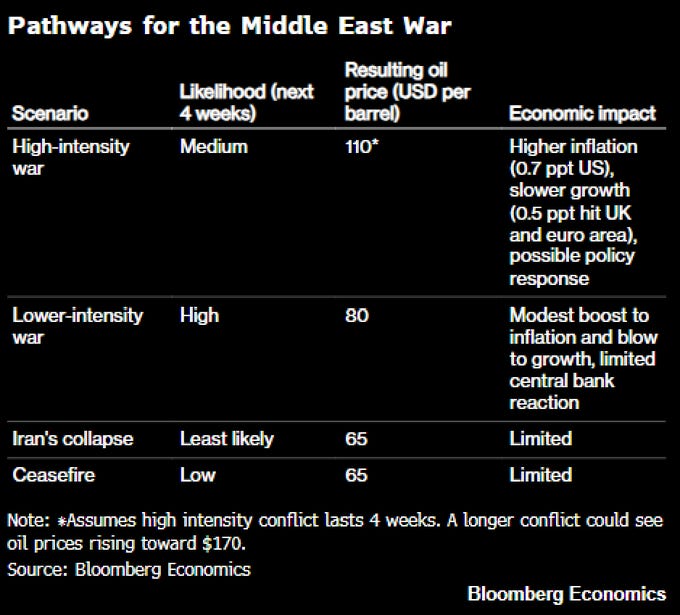
“President Donald Trump promised to ‘drill, baby, drill,’ but as the war in Iran stretches into its fourth week, he’s having a difficult time persuading U.S. oil and gas producers to expand production. The administration has said it’s been reaching out to oil companies to persuade them to speed their drills to help curb the steady rise in gasoline prices caused by the war with Iran, which has caused the largest disruption in global oil supplies in history. But so far that potential solution — like others before it — has failed to move the needle, as the market chaos brought by the war has left many in the industry unwilling to spend money on potentially unprofitable new wells. Trump himself has said that ‘when this is over, oil prices are going to go down very, very rapidly’ — not exactly a message that will convince companies to start drilling more, industry executives said. Much of the administration’s messaging has acted as a disincentive for drilling, said an oil and gas executive granted anonymity because they were not authorized to speak with the media. Facing blowback from Trump’s base over getting involved in another foreign war and the broader population for rising costs the intervention has caused, top Trump officials have contended the war will wrap in weeks and prices will quickly plummet. ‘[Treasury Secretary Scott] Bessent says oil prices will fall in a few months. It takes several months to stand up a rig and drill from scratch. Why would I expand my drilling campaign now if prices will fall?’ that executive said. Gasoline prices reached a national average of $3.91 a gallon on Friday, drawn up by crude prices that have risen $30 in the three weeks since the war started, potentially threatening Republicans’ chances at the polls in this year’s midterm elections. Prices are expected to climb further as Iran continues attacks on oil tankers traversing the Strait of Hormuz and widens its aggression against oil and gas fields in the Middle East in retaliation against the U.S. and Israeli military strikes that began nearly a month ago.” (Zack Coleman/Politico)