Weekend Reading
What fresh hell is this? #Incompetence #Corruption #Affordability

“Throughout each of his presidential campaigns, Trump promised a manufacturing renaissance. This was never likely to happen, despite bipartisan nostalgia for a bygone U.S. manufacturing era. That’s largely because we are now a services-based economy. But a resurgence was especially unlikely given Trump’s specific brand of America First policies, which includes raising costs of the inputs that U.S. manufacturers buy while also closing off export markets where these same U.S. manufacturers hope to sell their products. The result: There are approximately 80,000 fewer manufacturing jobs today than there were when Trump took office last year.³ Not coincidentally, steel prices here in the United States are about 40 percent higher than those in Western Europe. The increase in corporate bankruptcies last year was driven largely by industrial firms grappling with tariffs. The sweeping Trump tariffs have been painful enough. But lately, they have been coupled with new stressors resulting from his war with Iran. For example, aluminum prices are nearly double what they were a year ago, thanks to a combination of Trump’s tariffs; a shutdown at a U.S. aluminum supplier; and the closure of one of the world’s largest aluminum smelters, located near Abu Dhabi, which was struck by an Iranian missile. This has hit auto companies especially hard. In an earnings call last week, Ford said it expected its commodity costs this year to reach $2 billion, twice its previous projection, primarily because of rising aluminum prices.” (Catherine Rampell)
“In January, after weeks of threats by U.S. President Donald Trump to annex Canada as the ‘51st state,’ Canadian Prime Minister Mark Carney stood in Beijing’s Great Hall of the People, radiating cordiality toward the leaders of a country he had called Canada’s greatest geopolitical threat less than a year earlier. In a meeting with Chinese Premier Li Qiang, he said that ‘the progress that we have made in the partnership sets us up well for the new world order.’ It was not a great moment for the United States. Yet that scene—a leader anxious about Washington, rushing to Beijing with a newfound urgency—has played out again and again since Trump’s return to the White House. In 2025, the leaders of Australia, France, Georgia, New Zealand, Portugal, Serbia, Slovakia, Spain, and the European Union all traveled to China. In January, the pace of visits accelerated, with the leaders of Finland, Ireland, South Korea, and the United Kingdom arriving in quick succession, followed in February by Uruguay’s president and Germany’s chancellor. In April, Spain’s prime minister cemented the pattern with his fourth visit in four years. They walked red carpets, shook hands with senior Chinese Communist Party officials, and signed memorandums to shore up relations. The accumulating spectacle—what Chinese state media has called a ‘wave’ of visits—reinforced the CCP’s narrative of a rising China and a declining United States. Now these and other leaders are likely watching with trepidation as Beijing prepares to receive the president of the United States next week. For Canada and other U.S. allies and partners, the primary impetus for deepening ties with China is Trump himself. Under pressure from a United States behaving like a predatory hegemon, these politicians feel that they have no choice but to hedge. Meeting Chinese President Xi Jinping sends a signal to Trump that they have other options and will not be subordinated into all-or-nothing allegiances or unfair trade agreements. In this way, the growing distance between Washington and its partners is a diplomatic gift for Beijing.” (Michael Kovrig/Foreign Affairs)
“Last week, the Department of Homeland Security posted a press release on its official website with a large, bold headline: ‘Activist Biden Judge Releases Violent Criminal Illegal Alien Wanted for Murder.’ The release named the judge, Melissa DuBose, and went on to accuse her of knowingly freeing a murder suspect because she was, ‘an activist judge trying to thwart President Trump’s mandate from the American people to remove criminal illegal aliens from our communities.’ There was one problem. The judge had no idea about the murder case. That’s because the DOJ lawyer had failed to include that detail in arguing against release. And that in turn was because Immigration and Customs Enforcement (ICE) had instructed the lawyer to withhold it from Judge DuBose. The case vividly illustrates the untenable position of DOJ attorneys pressed into service to represent ICE. It is hard enough to work as a DOJ lawyer under the new regime, which has shredded the principles of federal prosecution and replaced them with an all-encompassing command to serve at Donald Trump’s quixotic pleasure. But add ICE as your client and the difficulty becomes nigh on impossible, as attorneys across the country have discovered while trying to represent an agency that ignores legal constraints, exhibits contempt for the rule of law, and withholds information from its own lawyers.” (Harry Litman/Talking Feds)
“The claims Samuel Alito, a supreme court justice, made about voter turnout in Louisiana in a landmark Voting Rights Act case were based on a misleading data analysis, a Guardian review has found. In his opinion gutting section 2 of the Voting Rights Act last week, Alito said that Black voter turnout had exceeded white voter turnout in two of the five most recent presidential elections, both nationally and in Louisiana. Alito’s claim was copied almost verbatim from a friend-of-the-court brief filed by the justice department. It was a critical data point Alito used to make the argument that the kind of discrimination that once made the Voting Rights Act necessary no longer exists. ‘Vast social change has occurred throughout the country and particularly in the South, where many Section 2 suits arise,’ Alito wrote in a majority opinion in the case, which concerned Louisiana’s congressional map, joined by the five other conservative justices on the court. ‘Black voters now participate in elections at similar rates as the rest of the electorate, even turning out at higher rates than white voters in two of the five most recent Presidential elections nationwide and in Louisiana.’ But a review of turnout and racial data in Louisiana reveals that assertion relies on an unusual methodology. The justice department brief that Alito cited calculated Black and white voter turnout in Louisiana as a proportion of the total population of each racial group over the age of 18. Such an approach is not preferred by experts in calculating statewide turnout because the general over-18 population may include non-citizens, people with felony convictions and others who cannot legally vote. But it does yield Alito’s conclusion that Black voter turnout exceeded white voter turnout in the 2012 and 2016 presidential elections in Louisiana. The widely accepted approach is to consider voter turnout as a proportion of the citizen voting age population or the voter eligible population, the latter of which excludes non-citizens as well as people who cannot vote because of a felony conviction or because they have been deemed mentally incapacitated.” (Sam Levine, Will Craft and Andrew Witherspoon/The Guardian)
“On November 12, 1991, Amy Goodman, an investigative journalist who was then a producer at WBAI Radio, and Allan Nairn, a correspondent for The New Yorker, were in East Timor covering the memorial of a man killed by the Indonesian army, when soldiers opened fire on the mourners, killing at least two hundred and seventy East Timorese. Goodman and Nairn were violently beaten. Nairn’s skull was fractured. By the time of the massacre, American media had spent sixteen years largely ignoring Indonesia’s brutal occupation of East Timor, even though the United States government had financed, trained, and armed the Indonesian army. ‘Most Americans never heard of this pure hell on earth,’ Goodman says in a new documentary about her life and career, Steal This Story, Please! Goodman and Nairn’s coverage proved pivotal in changing that. After their reporting was widely picked up by other outlets, the House voted to cut off all military assistance to Indonesia. ‘The massacre was horrific, it would change us forever, and it taught me how critical it was that we expose what is done in our name,’ Goodman says. Goodman, now the host of Democracy Now!, is the star of Steal This Story, Please! But it is more broadly a film about independent journalism and why it matters, now maybe more than ever. Goodman turns out to be an ideal guide: relentless, fearless, and a natural storyteller with a matter-of-fact clarity of purpose and no apparent interest in self-aggrandizement or martyrdom. She is often described as a progressive activist, but she denies that her work is partisan. Her focus is on broadening journalism’s aperture to include people typically marginalized by corporate media. ‘When you hear someone speaking from their own experience, it makes it much less likely you’ll want to destroy them,’ she says.” (Susie Banakarim/CJR)
“The ‘bustin out cryin’ phrase doesn’t sound at all like Epstein, and already online armchair sleuths and Epstein-ologists are declaring it fake for that reason. But it appears to have been a pet phrase of his - possibly from the Little Rascals series. We’ve found three emails in the DOJ library over the years in which Epstein talked - with a friend and with his brother - about ‘bustin’ out cryin.’ In a New Year’s Eve 2016 email to childhood friend Terry Kafka, in a discussion about missing their friend Warren Eistenstin, who died in 2014, Epstein wrote ‘Whatcha want me todo / bust out cryin’ . Kafka wrote ‘I get very nostalgic and truly miss warren. On nites like tonite.’ Earlier that year in an email to his brother Mark Epstein, who informed him that their cousin had become a grandfather, he had written ‘whtchoo want me todo -- bust out cryin’. Three years later in a March 2019 email to his brother, (subject line: ‘tits’), just a few months before his arrest, he wrote ‘what would you like me to say , do ? bust out cryin’ The similarity of the language and the uniqueness of the phrase certainly suggest that note is authentic. And in fact, Epstein was deemed suicidal by the Bureau of Prisons, had been found unresponsive in his cell and taken to the prison hospital several weeks before he was found dead in his cell. The question of whether he was murdered or killed himself has been hanging over the saga since practically the day he was found dead, with a broken hyoid bone.” (Nina Burleigh/American Freakshow)
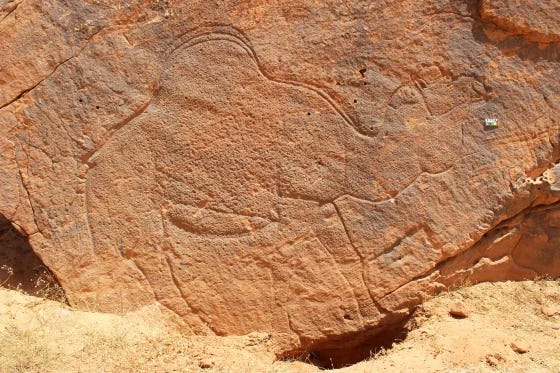
“Roughly 6,000 years ago, a culture of cattle herders roamed the harsh Atbai Desert, between the Nile River and the Red Sea in eastern Sudan. Researchers have located 280 stone burial monuments that attest to their existence. The tombs open a window into a lost moment in history when humans shared a unique connection with cattle. Using satellite imagery, an international team identified the 280 structures, 260 of them previously unknown. Spanning the desert, they all share a common monumental burial design typified by circular stone enclosure walls, according to a study published in the African Archaeological Review. ‘Despite being at the crossroad of the well-studied worlds of ancient Egypt and Nubia, the archaeology of the Atbai Desert, the region between the Nubian Nile and the Red Sea, is still in its infancy,’ the authors wrote. ‘This monumental feature, a local manifestation of common Saharan prehistoric burial practice, while exhibiting diverse architectural features, presents a consistent burial tradition across the entire desert expanse between the Nile and Red Sea.’ The monuments, which have been dubbed Atbai Enclosure Burials (AEBs) by the archaeologists who found them, have been dated to between 4500 and 2500 B.C.E. and measure up to 60 feet in length. Researchers opted to use satellite imagery to investigate the 175,000 square miles of desolate terrain around them due to the remote and dangerous nature of fieldwork in the war-torn country. The burials feature large, circular enclosure walls made with local stone surrounding internal burial chambers. ‘This tradition appears to be largely confined to the Atbai Desert, but there are rare cases of similar structures near the Nile Valley,’ the authors wrote … Environmental causes explain the rise and demise of the tomb-building tradition. The culture emerged during the African Humid Period and ended as the monsoon rains shifted south, reducing grazing land. The drying and loss of water sources made cattle raising impossible. The desert won and the herders were forced to the south, preventing additional monumental burial traditions from entering the landscape. The newly discovered tombs are remnants of a lost culture that was likely erased by a shifting environment.” (Tim Newcomb/Popular Mechanics via Yahoo!News)
“President Donald Trump has a lot on his plate right now. He’s engaged in a strange and aimless war with Iran in which his approach changes almost hourly. He remains obsessed with settling scores with enemies via weaponization of the justice system. He has a variety of vanity projects that seem to be of great importance to him, ranging from his beloved White House ballroom to the triumphal arch. He never seems to stop thinking about his hatred of voting by mail and the use of voting machines. And he is also spending a lot of time lately micromanaging Republican gerrymandering efforts around the country in hopes of moving the goalposts for the midterm elections. It almost seems lost in all the noisy day-to-day drama of Trump 2.0 that the single most important thing he and his party can do to win those midterms, addressing voters’ concerns about living costs, just isn’t happening. As Bloomberg’s Katy O’Donnell and Courtney Subramanian reported, Trump’s ‘affordability’ agenda is going nowhere fast … The president clearly is worried about one important cost-of-living indicator, the price of gasoline, as well he should be given his 2024 promises to lower pump prices. But his Iran war represented, among other things, a choice to tolerate and encourage high global oil prices with all the manifold consequences for costs across a wide range of goods and services. Perhaps oil and gasoline prices will come down before the end of the year and perhaps they won’t; at best, the president can only claim he has dug a deep hole and eventually filled it up. Unfortunately for Trump, the public isn’t as distracted from affordability issues as he is. The slow but steady decline in Trump’s job-approval numbers throughout most of his second term has been led by really terrible assessments of his handling of living costs. According to Silver Bulletin’s polling averages, Trump’s net job approval on ‘inflation’ hit minus-40 percent in late April. The most recent available poll on this issue, from Economist-YouGov on May 4, showed 25 percent of Americans approving of Trump’s handling of inflation/prices with 69 percent disapproving. And of that latter category, 54 percent disapprove strongly.” (Ed Kilgore/Intelligencer)
“CNN alums are sharing beautiful and sometimes mind-blowing stories about Ted Turner in the wake of his death at age 87. ‘One morning at 4am, he waltzed into the newsroom in the company of a dazzling woman, also wearing a white bathrobe,’ Eason Jordan wrote in this Medium essay. The woman was actress Raquel Welch. Jordan called Turner a trailblazer, do-gooder, bridge-builder, rabble-rouser and so much more. Sara Ganim, who more recently joined the ranks of CNN alums, wrote for Playboy that CNN reflected its founder in so many ways: ‘CNN, in its DNA, was always slightly unhinged. It was built by a man who thought the rules didn’t apply to him, in a city that wasn’t New York or Washington, staffed by journalists who didn’t get jobs at the networks...’ And in this essay for The Guardian, Lisa Napoli considers both the positive and negative impacts of the 24/7 news revolution. ‘Over time, we learned not just to turn on the news at any hour of the day but to expect it delivered to us, on the toilet or on the airplane, instantaneously,’ she writes. ‘And with each drip, we became further entertained — and paralyzed.’” (Brian Stelter/Reliable Sources)
“I’m still levitating from co-hosting the Truth Truth Summit and not just because Pope Leo XIV, such a steadfast supporter of freedom of the press, sent a personal message of solidarity to our holy moly media gathering. His imparting of ‘an Apostolic Blessing to all of goodwill participating in this summit’ must have been due to the celestial networking of my late husband, Sir Harry Evans, but my summit partners, Reuters and Durham University, and I were incredibly honored … Christo Grozev, the rock star investigative journalist who has exposed thousands of Russian spies and who also proved that it was Russian agents who poisoned the late opposition leader Alexei Navalny in Russia in 2020. Christo Grozev: ‘Finding spies is not a problem…Figuring out what they’re up to is the problem’ … Pulitzer Prize-winning historian, journalist, and author of Autocracy Inc., Anne Applebaum, brought her cerebral star power to a discussion with Russian journalist Anna Nemzer and Hungarian hero editor András Pethő about autocrats vs. the press. Anne Applebaum: ‘What really helps is to amplify the people who are doing the work on the ground. So the Hungarians, the Russians – link to them, post them, talk about them, refer to them, and make sure that people hear what they’re saying’ … “ (Tina Brown/Fresh Hell)
“ADMA was formally established in January 2022, but its foundations were laid earlier. Between 2018 and 2019, Taiwan undertook a series of military, strategic and organisational design reviews that exposed fundamental gaps in how it would resist Chinese military campaigns and coordinate civil and military capacity in a crisis. The reforms that followed addressed three interrelated problems: fragmented coordination across government agencies; the absence of legal frameworks for faster action in conflict; and the lack of a central body capable of integrating the full machinery of government. While this case for reform predated Russia’s full-scale invasion of Ukraine, the war in Ukraine subsequently became an important reference point for Taiwan. What ADMA’s architects understand – and Kyiv’s defenders have demonstrated since 2022 – is that modern national defence is not a military problem alone. Military forces may fight, but it is societies that sustain wars. The orchestration of government, industry, and civil society into a functioning and sustained wartime endeavour matters as much as military force structure at the start of a war. Ukraine’s influence on ADMA’s approach is openly acknowledged by the Taiwanese. The Ukrainian experience – a society mobilised in spirit, in organisation, and through the dispersal of critical functions to reduce vulnerability – shaped Taiwan’s efforts to build societal resilience. The all-out defence mindset ADMA seeks to instil in Taiwan’s citizenry draws explicitly on this experience.” (Mick Ryan/Futura Doctrina)