Weekend Reading
What fresh hell is this? #Affordability #Incompetence #Corruption

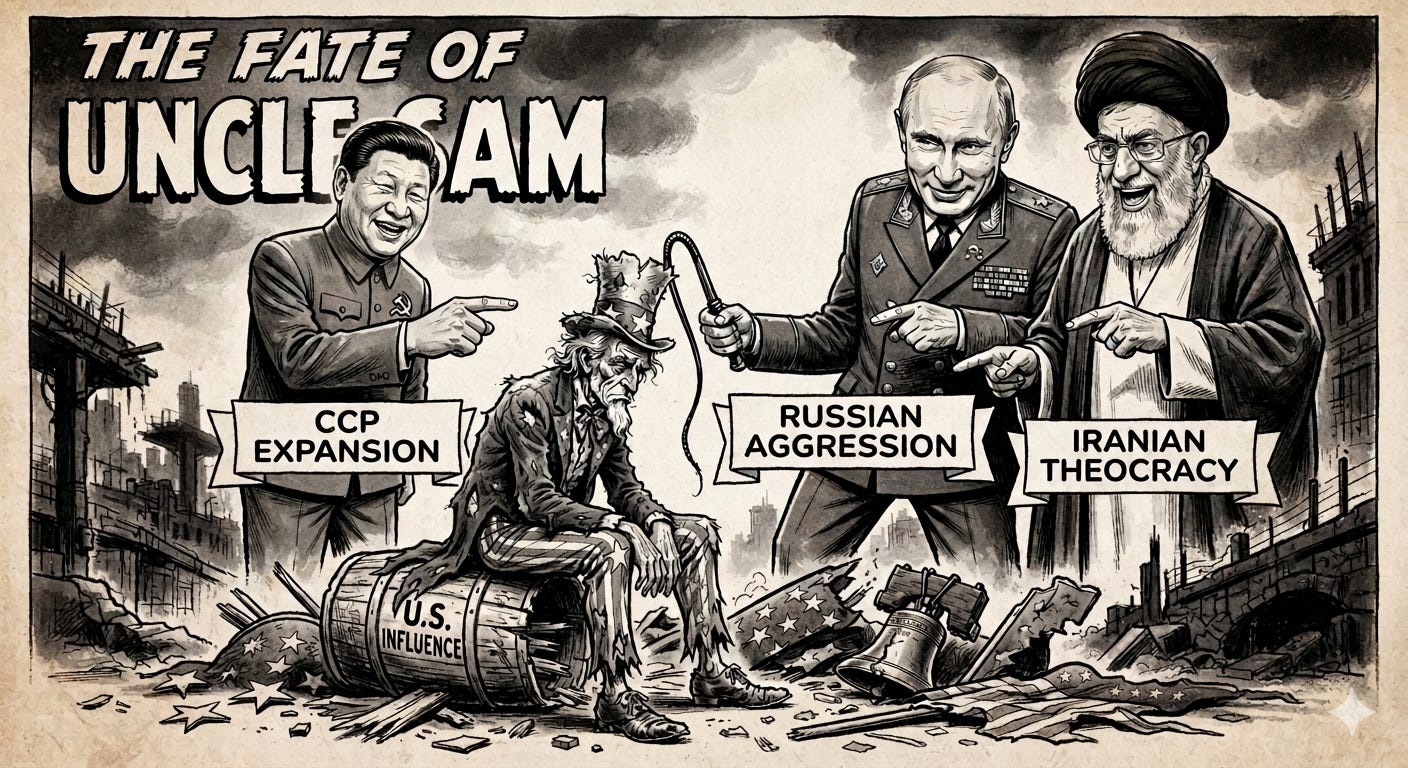
“The disintegration of U.S. power was well underway before Trump started his war on Iran, but the pace of decline has accelerated sharply since the magnitude of our defeat started becoming apparent. And when future historians write about this tale of self-immolation, they may well do so in Mandarin. China hasn’t been a direct combatant in the third Gulf war, and its support for Iran has, until recently, been discreet. (China is now reportedly preparing to send Iran advanced munitions — Phillips O’Brien suggests that it is ‘going in for the kill.’) But China has clearly relished our humiliation. And both the way the war has played out and China’s role have drastically shifted the global balance of power in China’s favor. China has been a serious geopolitical rival to the United States for some time. China’s manufacturing sector overtook the US in 2010, and the gap has continued to grow … A great deal has been written about the Trump administration’s attack on science, which is a topic largely separate from the Iran war. As one recent discussion put it, Trump officials have orchestrated a series of attacks on scientists and their laboratories, implemented through funding cuts, grant interruptions, and immigration restrictions. Scientists are gravitating to Canada, Europe, and China, and we are rapidly losing the depth of our innovative and essential scientific community. The undermining of other U.S. sources of strength was also underway before the Iran war, but the war has accelerated the downward spiral. Even before the bombing of Iran began, some observers worried about the state of the U.S. military. Had U.S. military leaders adapted to the new world — revealed by the war in Ukraine — of cheap, ubiquitous drones? How much damage had the pro-testosterone, anti-intellectual leadership of Pete Hegseth already done? Now we know the answers to these questions, and America’s military reputation has nose-dived. Oh, and as a December 2025 report from the Center for Strategic and International Studies points out, a Chinese supply chain underpins ‘the architecture of modern drone warfare.’ America’s dollar-linked financial power has also sharply declined.” (Paul Krugman)
“Saudi Arabia has drawn two of the Muslim world’s most formidable military powers into its defense as the Iran war moves closer to the kingdom. Pakistan and Turkey signed a NATO-style mutual defense pact with Saudi Arabia in Mecca on Friday, consolidating their longstanding security ties into a collective-defense alliance that stipulates an attack against any of them ‘shall be regarded as attack on them all.’ That commitment could draw Pakistan and Turkey into a war they have carefully kept at arm’s length. The official rationale for the agreement is ‘to strengthen collective deterrence against any act of aggression’ and further provide ‘for the enhancement of all aspects of defence cooperation among the three states,’ according to a statement released by all three countries. More specifically, the pact gives Saudi Arabia a powerful new layer of protection beyond its longstanding security partnership with the United States amid growing regional doubts over whether Washington can still be relied upon to protect its oil-rich Gulf allies. Turkey has the second-largest military in NATO, behind only the US, while Pakistan is the only nuclear-armed Muslim nation. Such powerful allies strengthen Saudi deterrence and present a united Sunni-led military front against a mounting Iranian threat … The pact also comes as Israel expands its military reach across the region and Riyadh’s relations with the neighboring United Arab Emirates fray. Pakistan and Turkey each share a border with Iran and both have strong reasons to prevent the conflict from spiraling. Pakistan must manage its sizeable Shiite population and its sensitive relationship with Tehran, while Turkey and Iran share concerns over Kurdish separatism despite competing elsewhere in the region. Tehran repeatedly struck targets in Saudi Arabia during the war, including civilian infrastructure, energy facilities and US interests. Direct Iranian attacks on Saudi Arabia largely subsided after an April 8 ceasefire took hold, but Iran-backed groups in Yemen and Iraq continued targeting the kingdom.” (Abbas Al Lawati/CNN)
“Turkey, Saudi Arabia and Pakistan signed a joint defence agreement on Friday, connecting the three largest Muslim countries in the world under one security umbrella for the first time. The deal, which has been under negotiation since last year, creates a significant new trilateral framework amid a deepening regional crisis following Israeli and US attacks on Iran … The pact would link three of the region’s largest countries, each with unique advantages. Oil-rich Saudi Arabia is the Arab world’s only G20 economy and home to Mecca and Medina, the two holiest cities in Islam. Pakistan is the Muslim-world’s only nuclear-armed state. Turkey, which straddles Asia and Europe, boasts Nato’s second-largest army. Pakistan is historically close to both Saudi Arabia and Turkey, but the latter two countries have not always seen eye-to-eye. Turkey’s President Erdogan backed popular protests following the Arab Spring that Riyadh saw as a threat to its monarchical system of governance. A decade ago, Saudi Arabia and the UAE joined forces to battle Turkey in Libya. They also supported Egyptian President Abdel Fattah el-Sisi, a former general whom Erdogan once denounced. But the region’s alliances have whipsawed. Erdogan and Sisi are moving closer amid joint concerns over Israel’s war on Gaza - recognised as a genocide by the United Nations - and broader attacks on Lebanon, Syria and Iran. Saudi Arabia and Turkey began patching up ties around 2021.” (Ragip Solyu/MiddleEastEye)
“In the summer of 2024, sitting in the shade of an enormous mango tree on the veranda of an ageing villa in Omdurman, I learned to distinguish between the sounds of outgoing and incoming artillery and mortar fire. When an outgoing projectile was launched from the Sudan Armed Forces (SAF) base in the city’s northern Wadi Saydna district, it made a thundering explosion that was interrupted within a second by a distinct metallic clink as the empty shell was expelled. By contrast, the incoming projectiles that the rebel Rapid Support Forces (RSF) fired from their positions across the Nile in Khartoum North made a whizzing sound as they dashed forward. If the sound intensified, it was closing in; if it faded, it had passed overhead. In either case, the whizz ended after a few seconds with a loud thud. What followed could not be measured in linear time: a silent interregnum in which time itself broke down, before reigniting in the gasps and shrieks of recognition, say, that a ceiling has collapsed. Omdurman is a town of predominantly sun-baked mud-brick houses, with distinct foci of concrete buildings. When war broke out in April 2023, the RSF had initially tried and failed to break into its northern districts, with the objective of besieging the Wadi Saydna base, which included a military college and airport. Next they resorted to firing on the area from a distance. After a year of shelling, its old, squat adobe structures, adequately designed for impending mortality, were left more shocked than shattered, while the new, taller concrete ones were aching and breaking. Throughout May and June 2024, I was on the receiving end of these daily RSF salvoes. I was with my parents, now in their late seventies, who had endured a year or so of life under rebel rule in old-town Omdurman, until the various inconveniences – a lack of running water, daily harassment at gunpoint – eventually forced them out, an undertaking that involved making generous bribes at RSF checkpoints. A friend of a relative generously offered them emergency lodging in his now-empty family home, built in the 1970s in a once-lush neighbourhood in the north of the city. His ailing mother had left town at the onset of war to join her older children, who were long settled in the Arab Gulf.” (Magdi El Gizuli/Equator)
“Ukraine’s long-range strike campaign has a clear lineage, one I have tracked across several articles here since the war’s early years. One of my earliest examinations was Striking Further, published in May 2023. In May 2023, two small drones exploded above the Kremlin’s Senate Palace. Whatever its precise origin, the strike signalled that the war Putin had started in February 2022 could reach the seat of Russian power. Writing in Striking Further at the time, I described Ukraine’s drone strikes on Moscow as a demonstration of the country’s ever-lengthening reach, part of a pattern of wartime adaptation that Ukraine has pursued more successfully than almost any other dimension of its war effort. By July 2023, strikes were reaching Moscow’s commercial and financial districts. Through 2024, the campaign broadened again, increasingly targeting the fuel depots, refineries and defence-industrial sites that sustain Russia’s war economy, as Ukraine’s Unmanned Systems Forces, established as its own branch in June 2024, matured into a sustained strike architecture. The scale of attacks accelerated markedly from 2025. A March 2025 strike saw more than 70 drones intercepted near Moscow in a single day, the largest attack of the war to that point. By March 2026, Ukraine was sending roughly 250 drones toward the Moscow region over three consecutive days, and had launched approximately 7,000 long-range drones against Russian targets that month alone, overtaking Russia’s own long-range strike volume for the first time. On 17 May 2026, Ukraine launched what Russian officials called the largest drone assault on the capital in more than a year, sending more than 500 unmanned systems into Russian territory and penetrating three of Moscow’s four air defence rings. President Zelenskyy described this campaign as Ukraine’s own ‘long-range sanctions’ against Russia. Those signals were deliberate. Two days before the strike, Zelenskyy said he had met with the leadership of the General Staff, military intelligence and the Security Service of Ukraine to discuss expanding long-range strike operations, a meeting that brought together most of the institutions the new command would later be built to unify. By mid-2026, the Ukrainian long-range strike campaign had become a continuous drumbeat of assaults on Russian targets.” (Mick Ryan/Futura Doctrina)
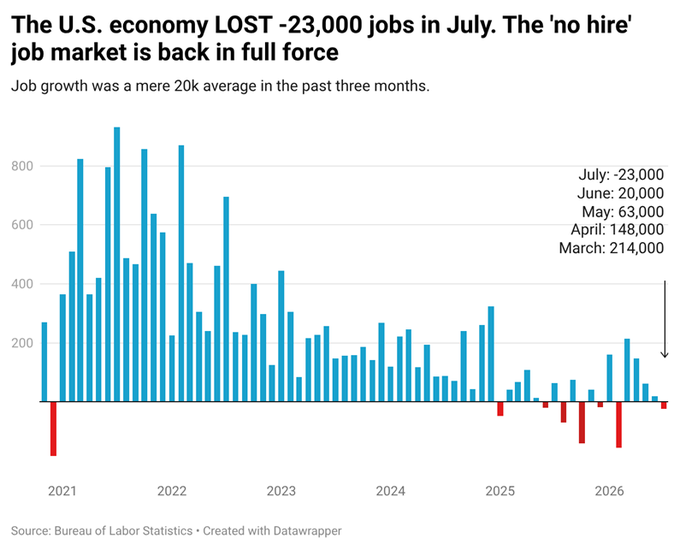
“If you step back, this bleak July jobs report means the labor market is stalling again.
Average job gains past 3 months: 20k
Average job gains past 6 months: 44k
Average job gains past 12 months: 26k
Average job gains in all of 2025: 10k
The strong jobs reports earlier this year have now faded. A ‘no hire’ job market is one with few opportunities and little dynamism.” (Heather Long/X.com)
“El-Sayed overcame the 12-to-one spending advantage of his establishment opponent, Representative Haley Stevens. William Lawrence, founder of the Sunrise Movement, also won the nomination for Michigan’s seventh House district, while Justice Democrat Donavan McKinney defeated centrist millionaire incumbent Shri Thanedar in the state’s 13th district. Coming off of big wins for democratic socialist candidates in New York and Colorado, the Michigan results not only demonstrate that insurgent left candidates are viable in statewide races in the Midwest; they also show a strong ability on the part of grassroots organizers to galvanize an activist base to a reform cause. That factor was notably lacking in the Democrats’ dismal 2024 showing, but became a vital source of strength in a low-turnout midterm cycle. One clear measure of this heightened grassroots enthusiasm: Jocelyn Benson, the winner of the gubernatorial primary who ran all but unopposed, garnered half a million votes more than the winner of the contested GOP primary did—a 60 percent increase in voter participation. Yet, at the leadership level, the opposition party continues to be stuck in doldrums mode. In political terms, Democrats are still on the back foot before the MAGA right’s multifront series of putsches yielding a brownshirt immigration police state, an open-auction model of Beltway corruption, and a concerted bid to place the toxic fable of a Christian nationalist ethno-state at the center of the country’s civic discourse. The Democrats’ fallback narrative is a pitch to return to normalcy—a fanciful evasion of the fundamental power shifts roiling the American polity since 2016, and an anemic overture to voters who crave basic changes to a top-heavy and oligarchic political economy.” (Chris Lehmann/The Nation)
“President Donald Trump is crashing out about a report that he confronted Defense Secretary Pete Hegseth over the U.S. military’s depleted munitions stockpile. Trump took to Truth Social less than an hour into Thursday to hit back at The Washington Post for reporting that tensions between Hegseth and the president had ‘boiled over’ on the sidelines of a Cabinet meeting at Camp David last week. ‘The U.S. has massive amounts of ‘munitions,’ especially of certain types,’ Trump wrote. ‘Additionally, large amounts are being manufactured and shipped to the U.S. as needed. Defense companies are building the largest number of plants and factories in our country’s history.’ ‘The ‘leakers’ of these treasonous statements are being hunted down. Long term jail sentences will be sought!’ Trump wrote. Notably, Trump didn’t deny unloading on Hegseth. This isn’t the first time the Trump administration has challenged reports that the country’s weapons stockpile is low, and still managed to threaten the leakers with jail time. If the story is false, then why would it be treasonous to tell it? The shortages of long-range guided missiles and air-defense interceptors caused Trump to pull back from launching any massive strikes against Iran, one source familiar with discussions told the Post. On Monday, the president claimed he’d changed his mind about launching ‘the biggest attack since World War II.’ Meanwhile, White House press secretary Karoline Leavitt insisted that the confrontation ‘literally never happened,’ but didn’t respond to the claims about the U.S. weapons stockpile.” (Edith Olmstead/TNR)
“Now that the Brits have charged the Tates and their long criminal history is out in the open and undeniable, Trumpworld wants to slither away from its old pals. But it can’t hide those long-standing ties to the pimp-pornographer rape cheerleaders for very long. The brothers are integral to the larger Trump Predators’ Ball: No White House in American history has been so packed with, or allied with, men accused of domestic violence, roofie rape, infidelity and pedophile protection. For years, the Trump team has cynically nurtured and profited from its connection to the Tates – to the detriment of American women’s health and safety, and with quantifiable political and economic gain. As we wrote last week, Barron Trump could and should be subpoenaed by the House Oversight Committee. He is widely credited as the link that brought the Tates and their blinkered, insecure younger male followers into Trump’s orbit. Men under 30 swung toward Trump by 15 to 20 percentage points in 2024. But Barron is hardly the only Trumpworld character with Tate ties who should be hauled in. And the family’s relationship with them isn’t just political. Don Jr. – back in his weak-chinned, pre-beard days – first invited Andrew Tate to Mar-a-Lago in 2017.” (Nina Burleigh/American Freakshow)
“The times are officially changin’. Now that i3 production has begun, BMW’s oldest manufacturing facility, its home-turf Munich plant, will exclusively build electric vehicles starting next year. This marks a huge turning point for the brand, as it phases out internal combustion models for its Neue Klasse EVs. It isn’t only a production milestone for the brand but a symbolic one. Munich is the site of BMW’s HQ and its Bavarian home, and it’s about to be fully electric. ‘The start of production of the BMW i3 heralds a new era for our main plant. With the fully-electric BMW i3, we are bringing together what belongs together: The 3 Series embodies BMW more than almost any other model—and Plant Munich represents our brand more than almost any other production site,’ said Raymond Wittmann, BMW board member responsible for production.” (Nico DeMattea/InsideEVS)
“Elon Musk’s DOGE promised to slash $2 trillion in federal spending and to make the federal workforce lean and efficient. But even the cost savings it has claimed in an online ‘Wall of Receipts’ of the smaller amount of $110 billion didn’t check out, according to a report the Government Accountability Office published Thursday. The GAO evaluated $110 billion of savings DOGE claimed on a website with its ‘Wall of Receipts’ from cuts including federal contracts, grants and leases. The GAO said it found multiple ‘issues limiting the transparency and reliability of these reported savings.’ Including additional categories beyond contracts, grants, and leases, DOGE tallied $215 billion in cuts, the GAO said. The findings further undercut claims by Musk and President Donald Trump that they have made meaningful cuts in government spending and call into question the effects of the DOGE effort that slashed federal spending with little notice to agencies and slashed hundreds of thousands of government jobs. The GAO found that of the 13,476 contracts DOGE claimed it terminated, ‘no termination action’ was taken on 2,503 of them. The report also noted DOGE had claimed $113 million in savings from cuts to 264 leases, but GAO found that information overstated the savings. The leases cut and referenced on DOGE’s website ‘actually summed to $53.5 million’ in savings, the report found. Of the 264 leases, about 108 were already in the termination process before DOGE was formed after Trump began his second term as president, the GAO report also said. The report was requested last year by Sens. Gary Peters (D-Mich.) and Richard Blumenthal (D-Conn.) who are, respectively, ranking members of the Senate Homeland Security and Governmental Affairs Committee, and of the panel’s investigations subcommittee.” (Lora Kolodny/CNBC)
“When African states emerged from colonial domination in the late 1950s and early 1960s, they inherited a map mostly drawn for imperial ends. The scramble for Africa (1884–1885), formalized at the Berlin Conference, produced borders that cut across deserts, forests, rivers and ridges without regard for local political realities. Many new leaders recognized that these borders were neither natural nor just; they also feared that redrawing them would unleash endless conflict. The newly independent countries thus adopted a powerful consensus: the colonial borders must remain inviolable. This principle was viewed through the prism of uti possidetis juris—the doctrine, first applied in Latin America, that colonial administrative borders become international borders upon independence. The International Court of Justice (ICJ), notably in the 1986 Burkina Faso/Mali case, explicitly linked the 1964 Cairo Resolution to uti possidetis, grounding African borders in colonial law, a jurisprudence that still shapes the African Union Border Programme (AUBP), which aims to delimit 80 per cent of African boundaries by 2027. Yet, conflating Africa’s principle with uti possidetis obscures important differences. The African principle is broader and more political: it prescribes neither how a border must be drawn nor how disputes should be resolved; it simply forbids the forcible alteration of borders and obliges states to settle disagreements peacefully. Moreover, only a minority of African borders resulted from a single colonial power’s internal administrative line; many were products of bilateral treaties between rival empires. In Central Africa, French, Belgian, German, British, Spanish and Portuguese claims intersected and overlapped. The practical effect, nonetheless, was to freeze the colonial map. Stability was purchased at an exorbitant price: 54 dysfunctional rump states. Borders that split ethnic groups created permanent minorities whose loyalty was always suspect; landlocked states depend on the goodwill of neighbours for port access; and infrastructure networks designed to extract resources toward imperial metropoles (with Beijing supplanting Paris and London) run parallel to borders rather than across them, fragmenting regional economies. From 2009 to 2011, according to the World Bank, these divisions cost Africa up to two per cent of annual growth, a figure magnified by climate shocks and migratory pressures.” (Andréa Ngombet/The Republic)