Operation: Turkish Delight
What fresh hell is this? #Affordability #Incompetence #Corruption

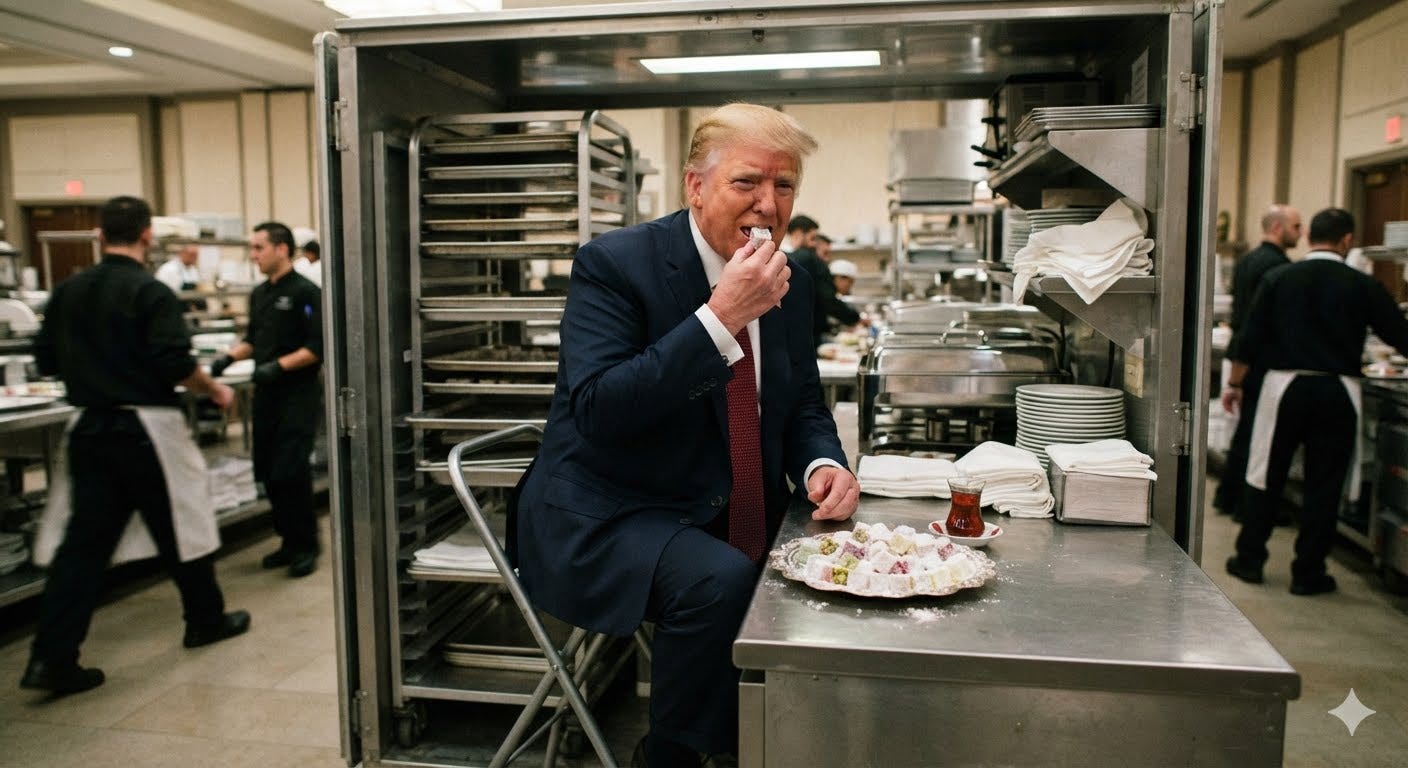
That last month the President of the United States was whisked out of Turkey in a catering container like — and how does one put it kindly? — a Kebab. CNN reports that President Trump’s “Turkish Deception Operation” to sneak out of Ankara in an alternative jet, nestled inside a catering cart, was the result of a specific, credible threat of an Iranian shoulder-fired missile. The press, however, were left to fend for themselves on the decoy plane. Along with Marco Rubio, who has to be, at this point in the game, wondering where all the love has gone? What’s with the fall-off?
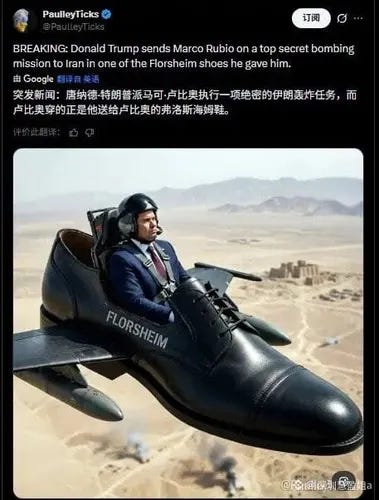
This is the same Turkey that in August signed the Mecca Joint Defense Agreement with Saudi Arabia and Pakistan, framed as a collective security hedge against regional instability and shifting U.S. commitments. Further, the public admission of this calculated misdirection is somewhat unusual, considering Secret Service operations involving POTUS seldom make A-1 above-the-fold. Maggie Haberman, Eric Schmitt and Zolan Kanno-Youngs of The Times, as you can imagine, were not amused at the fact that their ink-stained brothers and sisters were left as Persian missile bait:
Reporters on the older plane were not told that Mr. Trump had not flown with them from Turkey to an air base in Britain, making them unwitting participants in the ruse and leaving them, along with some White House staff members, to serve as unknowing decoys.
After Mr. Trump arrived in Britain, he was secretly moved back to the older version of Air Force One. He then disembarked in view of reporters and walked across the tarmac to the plane donated by Qatar, which he flew to Washington.
The elaborate plan appears to have been developed in a matter of hours after officials determined that a threat against Mr. Trump from Iran was credible. It came after years of threats against Mr. Trump from Iran and amid the war he launched against that country. And it was an unusual instance of the public being deceived about a president’s whereabouts.
Officials have not previously acknowledged that Mr. Trump was not where they claimed he was.
Because Washington DC is what it is, Haberman, et al, are making this all about: a) Themselves — and, b) the Horserace. Washington, man. Who, among those satelliting the Sun-King, is “In”? Who is “Out”? Gotta read Axios to get the answer! The power game as played by Nature’s most sophisticated apes. (Averted Gaze) “Trump had been accompanied to Turkey by several senior officials, including Rubio, Bessent, Hegseth and Joint Chiefs of Staff Chairman Gen. Dan Caine,” is how CNN’s Kevin Liptak begins, ominously. “But not all would join the president when he left.” *Shudders*
Status, ladies and gentlemen of the jury, the coin of the realm in DC. So, yesterday my social media oscillated wildly with outrage — outrage! — that Trump would sacrifice the potential safety of journalists. Mamma says whaaa-a-at?! That Donald Trump would use Washington journalists as assassination decoys? Borborygmus was the pearl-clutching on Media Twitter yesterday evening.
But isn’t that on-brand for MAGA? At what point did POTUS ever, ever show loving-kindness for the safety and wellbeing of journalists? Trump is just too damn dusty to show any such grace. When one is in the midst of a 5-alarm democracy fire, its a far wiser thing to focus on the big stuff a blazing and leave the advocacy on behalf of the fourth estate to the White House Correspondents’ Association. Besides, what percentage of MAGA would just find amusing the notion of Trump potentially sending the Washington Press Corps into the line of fire of an Iranian shoulder-fired missile? The cruelty is the point, dear reader. MAGA is not a political philosophy — it is a sadistic mood. And it is flooding the zone with intentional misdirection.
That having been said, the court intrigue portion of the press corps overreaction — regarding Who-Is-Up-and-Down in TrumpWorld — is not entirely uninteresting. Says Liptak:
The aides with Trump on that smaller plane included Natalie Harp, an executive assistant who regularly accompanies Trump when he travels; Dan Scavino, a deputy White House chief of staff; and Walt Nauta, the director of Oval Office operations who also frequently travels with the president.
Defense Secretary Pete Hegseth also traveled with the president on the smaller C-32A that took off from Ankara, while Secretary of State Marco Rubio and Treasury Secretary Scott Bessent stayed on the larger plane.
Always, Natalie Harp. Always camera-ready, with meticulously styled hair as Daddy likes it. With her portable printer, rechargeable batteries and stacks of paper packed inside a bag soas to quickly provide POTUS with physical copies of MAGA fanfiction. The Human Printer. Her gold-leaf tresses matching the signature aesthetic of Trump family women, particularly Ivanka Trump …

But there are far more important issues to discuss. Like the fact that Iran was willing to go that far. An attempted assassination of the sitting US President can only be properly construed under the category of next level. Also, that it is showing an enormous pain threshold during the course of this war. Using asymmetrical leverage, Persia — where Chess, incidentally, was invented — is exacting a heavy price on Trump’s domestic audience as well as his international reputation in the run-up to midterm elections. Foreign Minister Araghchi’s cockiness speaks voilumes.
And Iran is not alone. In March, we learned that a fearless China was sharing intel with Iran about US troops. From Sascha Ingber:
The intelligence is mainly GEOINT from satellites, the person said. And it did not start immediately, when Operation Epic Fury began. Beijing started sharing intel about ten days to two weeks into the war, the person said. That would be March 10 onward.
According to CBS News, The U.S. State and Treasury departments sanctioned multiple China-based firms for supplying satellite imagery used to target —?! — American positions. Trump Spokeswoman Olivia Wales did not contradict or challenge Ingber’s intel. Instead, she told her by email, “Nothing provided to Iran by any other country is affecting our operational success.” Further, Russia is providing, according to WSJ, shared Satellite Imagery and Drone Technology with Iran.
All of this distressing news comes amidst an acute shortage of high-end precision missiles and air defense interceptors. Has the American Empire, like all Empires before it, simply overextended itself? With a little bit of calculated collusion from the Russo-Sino-Iranian bloc? We cannot fail to note here that these three anti-demorcatic actors, all determined to accelerate a multipolar age at the expense of American dominance, are working in confluence with one another and learning. “Where learning once took years to be absorbed into an organisation, and longer still to share between organisations and nations, members of (the authoritarian) community can now access a lesson almost as soon as one of them collects and analyses it,” writes Mick Ryan, of what he calls The Adaptation War. “When one competitor learns of an American or Western military weakness or vulnerability, all of them can benefit from the insight almost immediately (if they have the absorption capacity to do so).” Charmed, I’m sure.
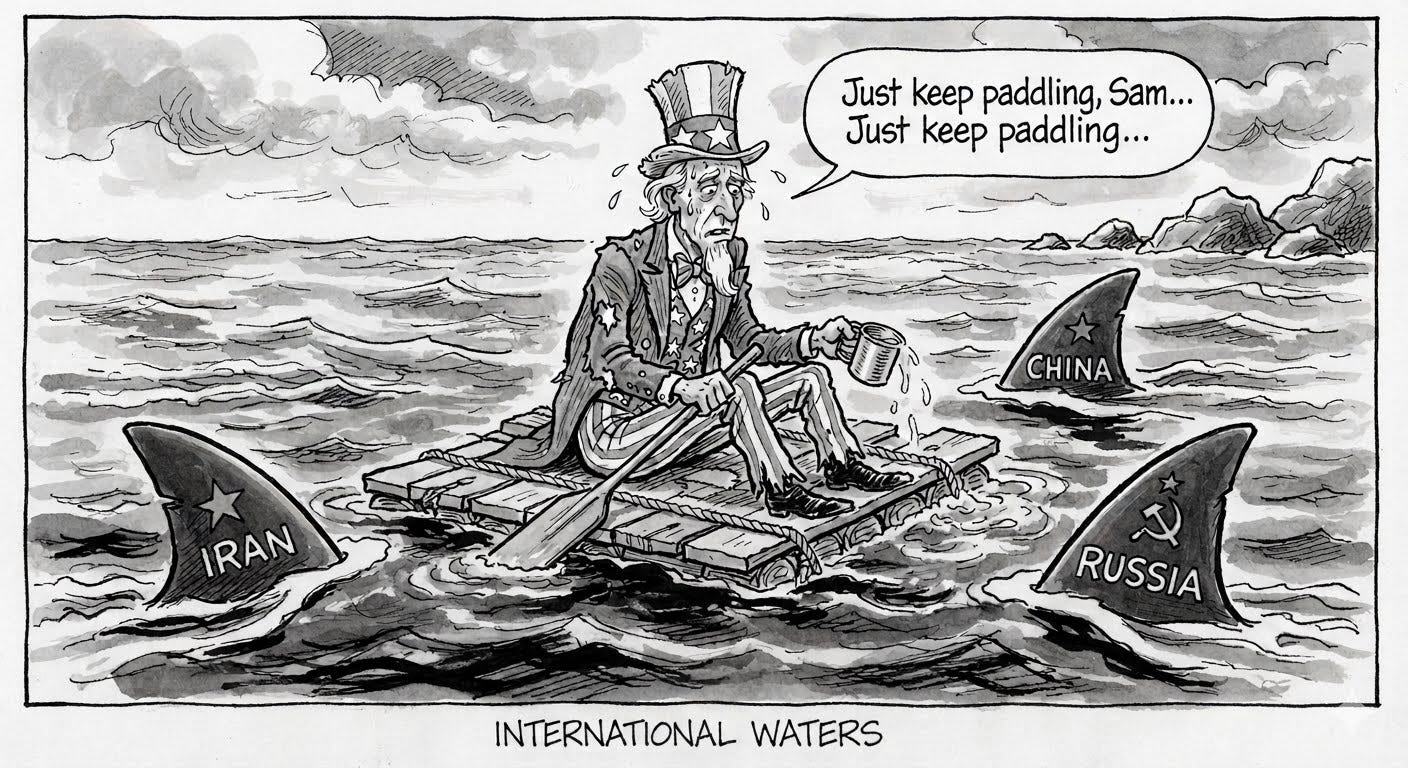
Can we still deter China, if the need arises? And — most important — Do we even have the will to anymore? Does the anti-imperial far left? Does the America First-y far right? Further, the Center is a bloodless, ambitious beast; it has no chic. Did Trump’s hemispheric flex signal benign neglect of the South China Sea? The Russo-Sino-Iranian bloc, when in synchrony, is formidable in ways that Trump, a blunt-force instrument at best, wholly incapable of diplomacy, is not. And one of China’s top strategic goals vis-a-vis the United States is to neutralize American leverage in the Indo-Pacific region. By discretely helping to deplete America’s high-end precision missiles and air defense interceptors in the Middle Eastern theater contributes mightily towards that goal. Again: Just saying.
From Time’s Ariane Tabatabai and John Drennan:
European intelligence officials disclosed that Iran shares information with Russia so freely that Russian officials knew of a strike that killed Ali Larijani, Secretary of Iran’s Supreme National Security Council, before the news broke anywhere else. This information-sharing runs both ways: Russian intelligence has reportedly supplied targeting details for Iranian attacks on U.S. forces and partners in the region, using the Shahed drones Tehran had once sent to Moscow for use against Ukraine—but now fitted with Russian upgrades.
Officials at the U.S. Defense Intelligence Agency indicated that the Islamic Revolutionary Guards Corps had been planning missile and drone strikes using AI-annotated imagery of American bases published by a Chinese satellite firm. CNN reported, citing people familiar with American intelligence assessments, that Beijing was preparing to ship air-defense systems to Iran through third countries to mask their origin.
Such collusion should not have come as a surprise.
No, it should not. Not to a seasoned leader not learning on the job. But what, if anything, are we going to do about it? That is, of course, if we are even still able after Pete Hegseth’s slattern incompetence.
“(Peter) Thiel originally delivered ‘The Straussian Moment’ at his 2004 self-funded conference Politics and the Apocalypse, and later published it as an essay. Ostensibly, it’s a response to the terrorist attacks on 9/11, but more accurately, it’s a series of philosophical loop the loops that weaves the work of René Girard, Leo Strauss, and Carl Schmitt into an argument for transforming the United States into an authoritarian Christian nation-state. Thiel begins by asking how the US, with all its resources, could be brought to its knees by the Taliban, failing to ‘deter a handful of crazy, determined, and suicidal persons.’ He concludes that it’s because ‘the new science of economics and the practice of capitalism filled the vacuum created by the abandonment of the older tradition.’ This older tradition, according to him, is straightforward Christian nationalism dragged through a fever dream of the Middle Ages. To put it plainly, Thiel thinks that the United States has abandoned religion and the Enlightenment has failed. The world has become a globalized, godless place where all choices are equally valid and we have fallen into a live-and-let-live passivity. This has brought an empty-headed peace, fanatically protected by liberals under the guise of multiculturalism, though in reality they’re dazzled by cheap consumer goods and driven by envy to protect the system that supplied them. In this anti-society, intellectuals are punished for even mentioning that cultures used to have distinct differences and, in his opinion, echelons. In Thiel’s mind, the Christian West must remember who they are if they are to defeat Muslims from the Middle East. They must realize their culture and religion are superior in order to reinvigorate themselves to fight for it.
The title of Thiel’s lecture is never mentioned in Communion, but a professor would be within her rights to mark it as uncited source material.” (Elizabeth Harper/LARB)
“Sudan occupies a unique geostrategic position at the intersection of the Middle East, the Horn of Africa and the Sahel, linking the Red Sea corridor with sub-Saharan Africa. Its long Red Sea coastline, abundant agricultural land, mineral resources and proximity to some of the world’s most critical maritime trade routes make it a pivotal component of an increasingly interconnected security space stretching from the Gulf to the Horn of Africa. Rather than representing a peripheral African ‘forgotten conflict’, Sudan has become one of the clearest manifestations of the growing interdependence between Middle Eastern and African security dynamics. Paradoxically, Sudan’s growing strategic relevance has coincided with declining international attention. The war has been overshadowed by the conflicts in Ukraine, Gaza and, more recently, the military confrontation between the United States, Israel and Iran. Yet, these crises form part of the same evolving regional security environment in which developments in the Gulf, the Red Sea and the Horn of Africa increasingly shape one another … The United Arab Emirates (UAE) has emerged as the single most influential external actor in the conflict. Although Abu Dhabi continues to deny allegations of military involvement, multiple authoritative investigations – including by the UN Panel of Experts on Sudan – have documented extensive logistical and military support to the RSF through neighbouring countries, particularly Chad, Eastern Libya under Khalifa Haftar’s control and, according to several investigations, additional hubs in Ethiopia, South Sudan and Uganda.” ( Sara De Simone/ISPIOnline)
“Far out in the Pacific Ocean, Ecuadorean fishermen have been attacked by unidentified ‘gringos’ using drones, survivors say, spurring a mystery over whether the American military, the armed forces of another country or private military contractors were behind the strikes. One fishing boat has been lost at sea since January, the U.N. says, with eight people still missing and presumed dead. The survivors of two other vessels said they came under attack in March by English-speaking assailants wearing matching uniforms with American flag patches, but without any clear insignia to link them to an official government force. Some of the surviving fishermen said they had been hauled out of the water, questioned and then handed over to El Salvador’s navy before being released. The Pentagon has denied involvement, as has the U.S. Coast Guard. Survivors have also said that a plane followed and seemingly surveilled them before the strikes. The New York Times analyzed flight data and found that a maritime patrol plane — based out of a military base in El Salvador — flew in the direction of all three boats in the days before they were attacked. The pilots onboard spoke English with American accents, according to air traffic control communication recordings … Washington has not been shy about claiming the strikes, often publishing footage on social media of tiny fishing boats cutting through the water before being obliterated by American munitions. These attacks, however, have gone unclaimed. It is certainly possible that the U.S. or some other military has conducted clandestine attacks on boats in the region. But the many lingering questions surrounding the fishing boat attacks have led some experts to wonder whether a private military contractor has been hired by the U.S. government or one of its Latin American allies — possibly El Salvador, where the plane has operated.” (Maria Abi-Habib, Riley Mellen, José María, León Cabrera and Christiaan Triebert/ NYT)
“The US remains widely popular in Africa but is falling behind China, according to the most comprehensive bi-annual survey of public opinion across the continent. The flagship 2026 report of the Ghana-based Afrobarometer shows that positive perceptions of the US dropped by 10 percentage points between 2019-2021 and 2021-2023, from 59% to 49%, before only partially recovering to 53% in 2024-2025. Over the same period, Africans’ opinion of China has remained steady, with 62% of respondents approving of Beijing’s impact. ‘To the extent that there is an emerging winner in the contest for Africans’ allegiance, China appears to be coming out on top, holding steady in popular assessments, while the US is losing ground and Russia struggles to gain it,’ concludes the report, which was published on 5 August. Of the 38 countries included in the latest round of surveys, only nine were polled before President Donald Trump’s inauguration. They include South Africa, where negative perception of the US has almost doubled since 2019-2021 to 33% today, and Mozambique, where support for the US is down five percentage points, with 59% holding a positive view. While she avoids predicting future African attitudes, Afrobarometer senior adviser and former director of Analysis and Capacity Building Carolyn Logan says Trump’s policies can be expected to further dampen America’s image in many countries.” (Julian Pecquet/The Africa Report)